How to use Setboard
Ten minutes from opening your library to a crate in Serato. You need Chrome or Edge and a Serato DJ library.
1. Open your library
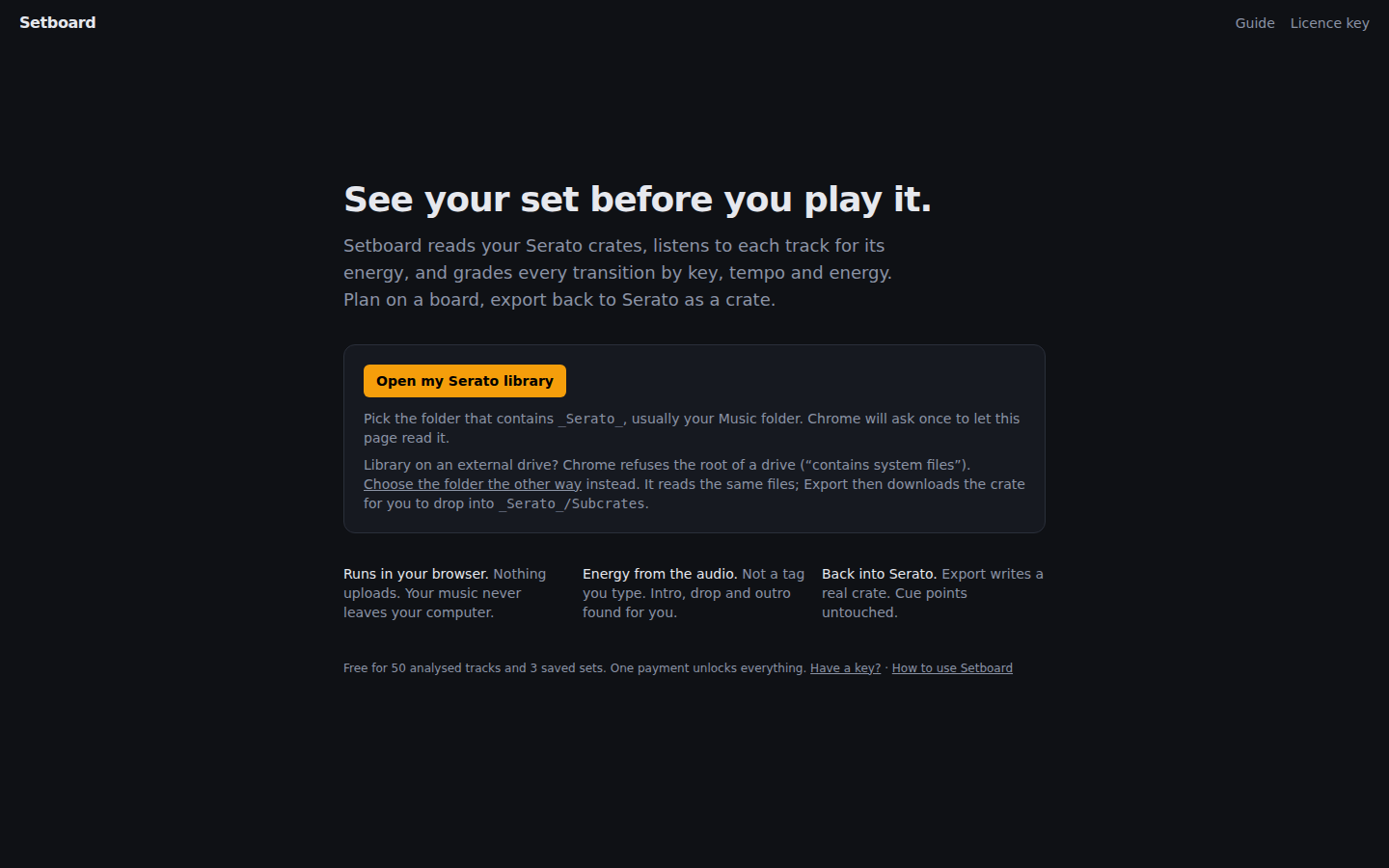
Go to the app and click Open my Serato library. Pick the folder that contains _Serato_. On most computers that is your Music folder. Chrome asks once whether the page may read it; Setboard remembers the folder for next time.
Your crates appear in the dropdown on the left, with each track's BPM and key as Serato has them. Nothing is uploaded; the page reads the files directly from disk.
2. Analyse a crate
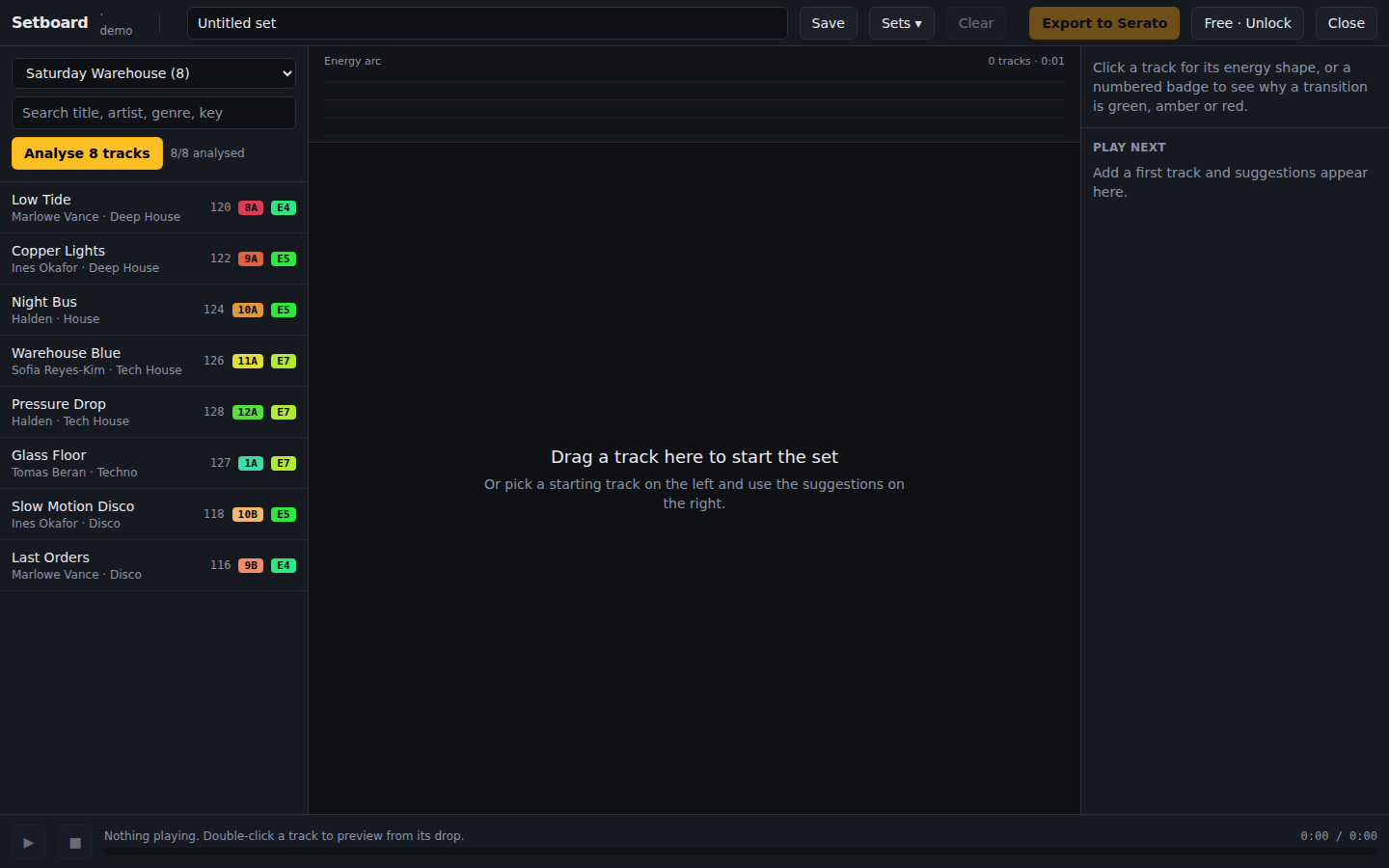
Choose a crate and press Analyse. Each track is decoded and measured on your computer: an energy score from 1 to 10, the length of its intro and outro, and where the first drop lands. If Serato has no key or BPM for a track, Setboard detects them.
Analysis runs one track at a time and takes a few seconds each. Results are cached, so a crate only takes time once. The free version analyses up to 50 tracks.
3. Build the set
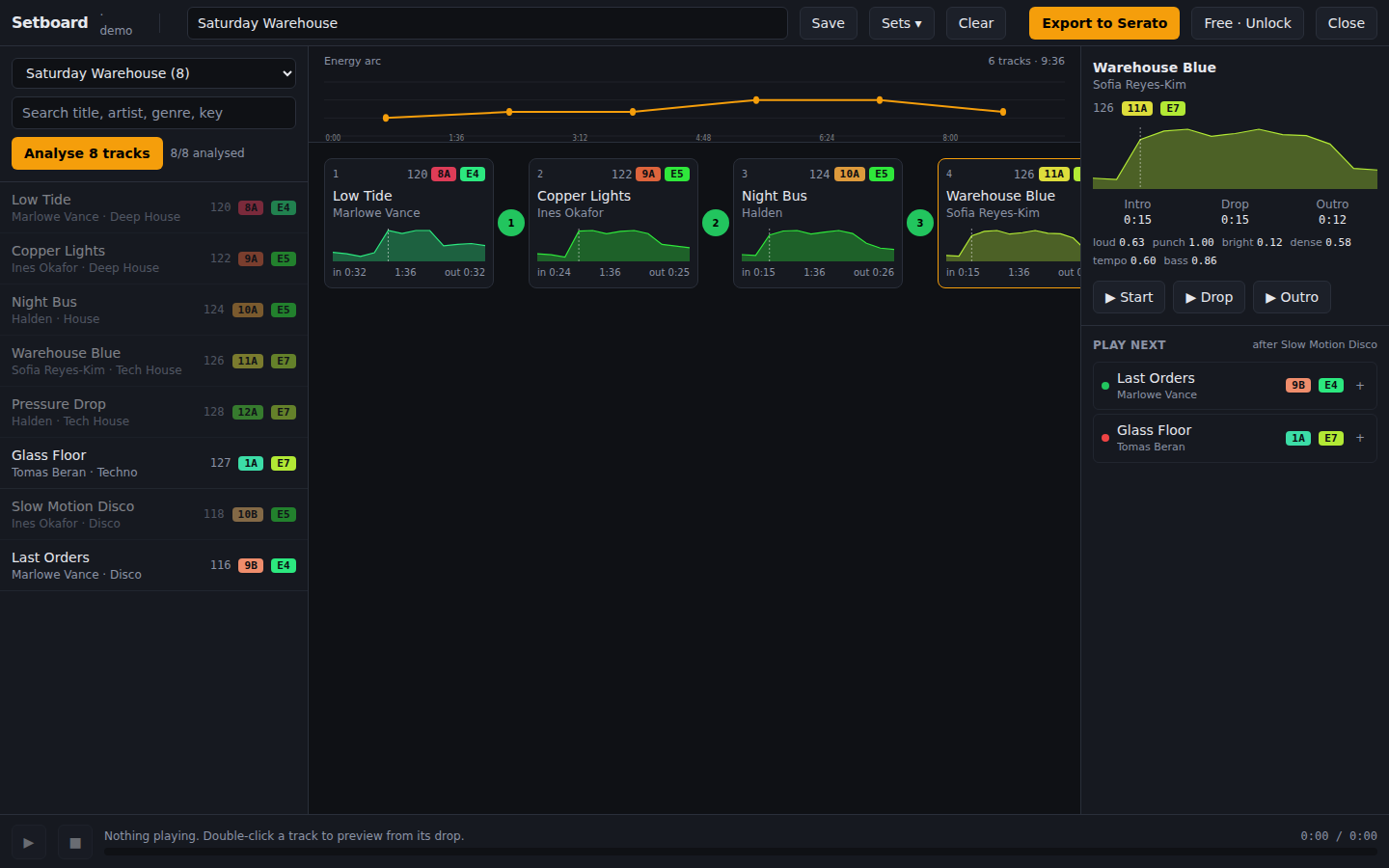
Drag tracks from the library onto the board, or hover a track and press +. Cards sit in play order. Drag a card to move it, press the × to remove it, or select it and press Delete.
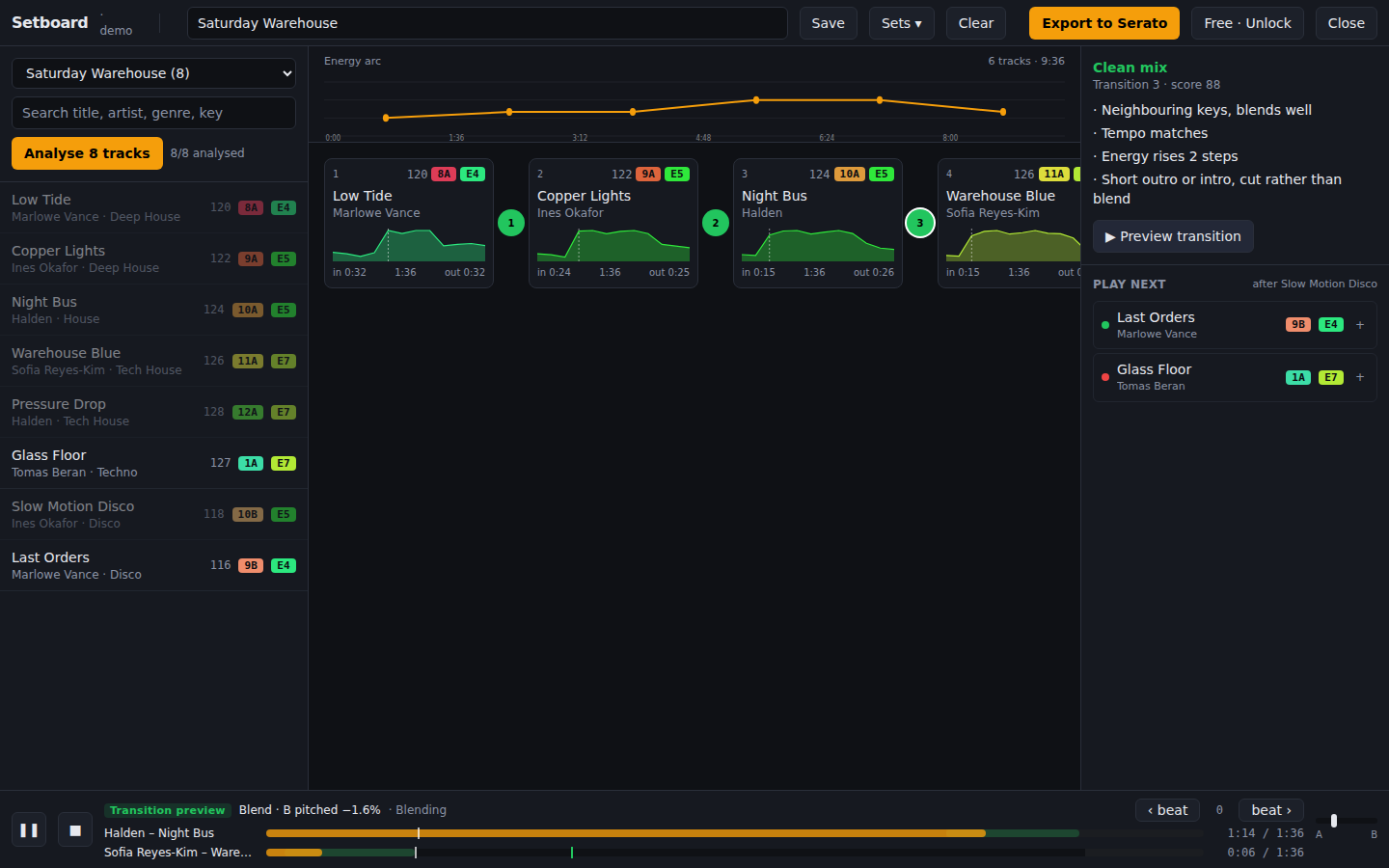
Each card shows the track's loudness over time. in is the intro length, out the outro length, and the dotted line marks the drop. The energy arc above the board plots one dot per track so you can see the shape of the night at a glance. A sag in the middle is the kind of thing it is there to show you.
Click a card and the Inspector on the right shows its intro, drop and outro, with Start, Drop and Outro buttons to listen from each point. Double-click any track to play from its drop. Under Play next the Inspector ranks the rest of the crate by how well each track follows the last one on the board.
4. Read the transition badges
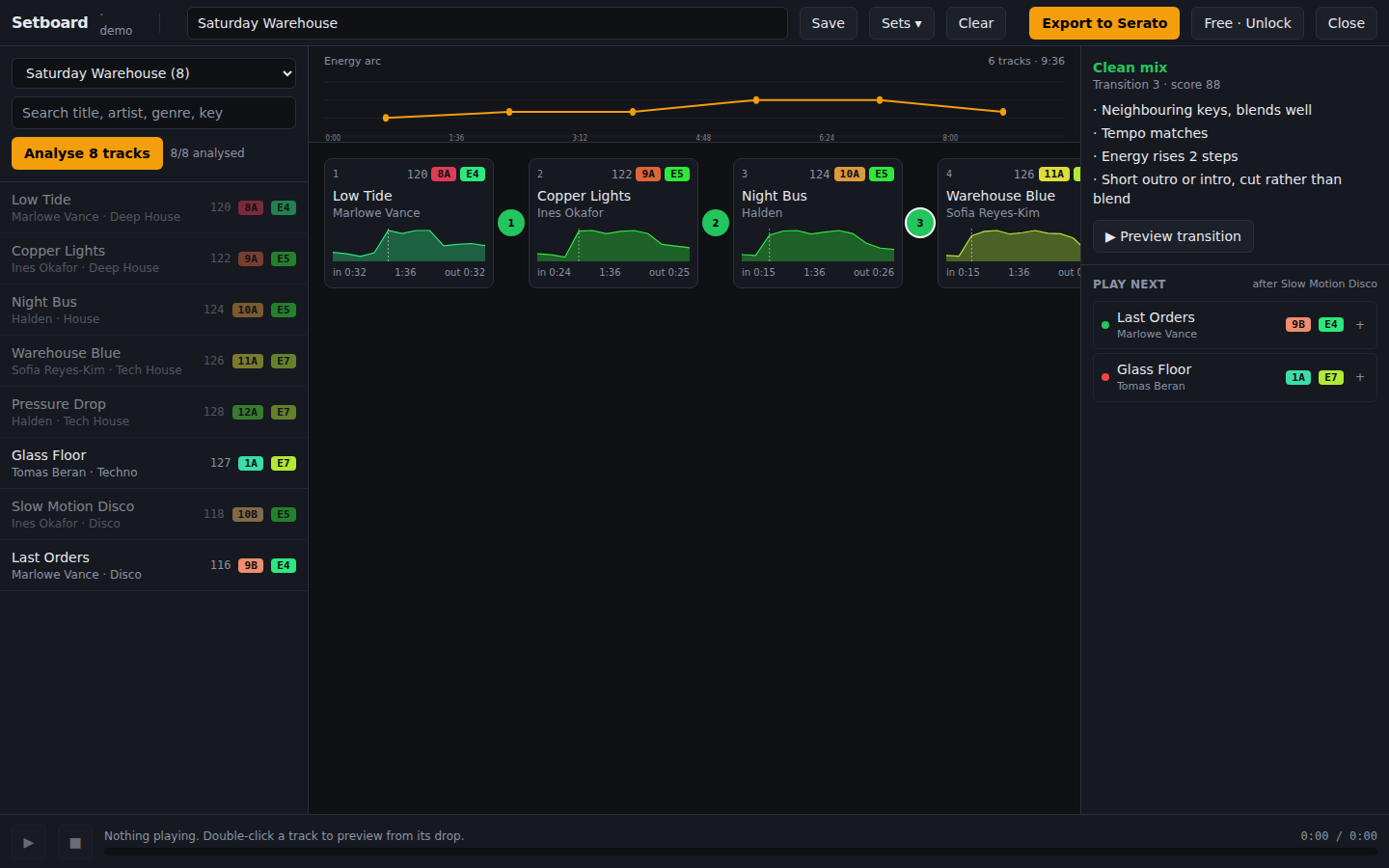
The numbered circle between two cards grades that transition. Green should mix cleanly, amber is workable, red is likely to clash. Click a badge and the Inspector explains it:
- · Key: same key, a neighbour on the Camelot wheel, relative major or minor, an energy-boost move, or a clash.
- · Tempo: how far apart the BPMs are and whether that is a pitch-fader move or a jump.
- · Energy: how many steps up or down the score moves.
- · Room to blend: whether the first track's outro and the next track's intro are long enough to overlap.
5. Preview a mix
With a badge selected, press Preview transition. Setboard mixes the two tracks the way you would:
- · Blend: when the tempos are within 8 % (half and double time count), the first track's outro plays under the second track's intro with a crossfade, and the second track is pitched to match.
- · Cut: when the tempos are further apart, the first track stops where its outro begins and the second drops straight in from its first downbeat.
The player bar shows both decks, the overlap, and a crossfader that moves as the blend happens. If the downbeats don't line up, ‹ beat and beat › shift the second track by one beat. Space pauses and resumes.
6. Export to Serato
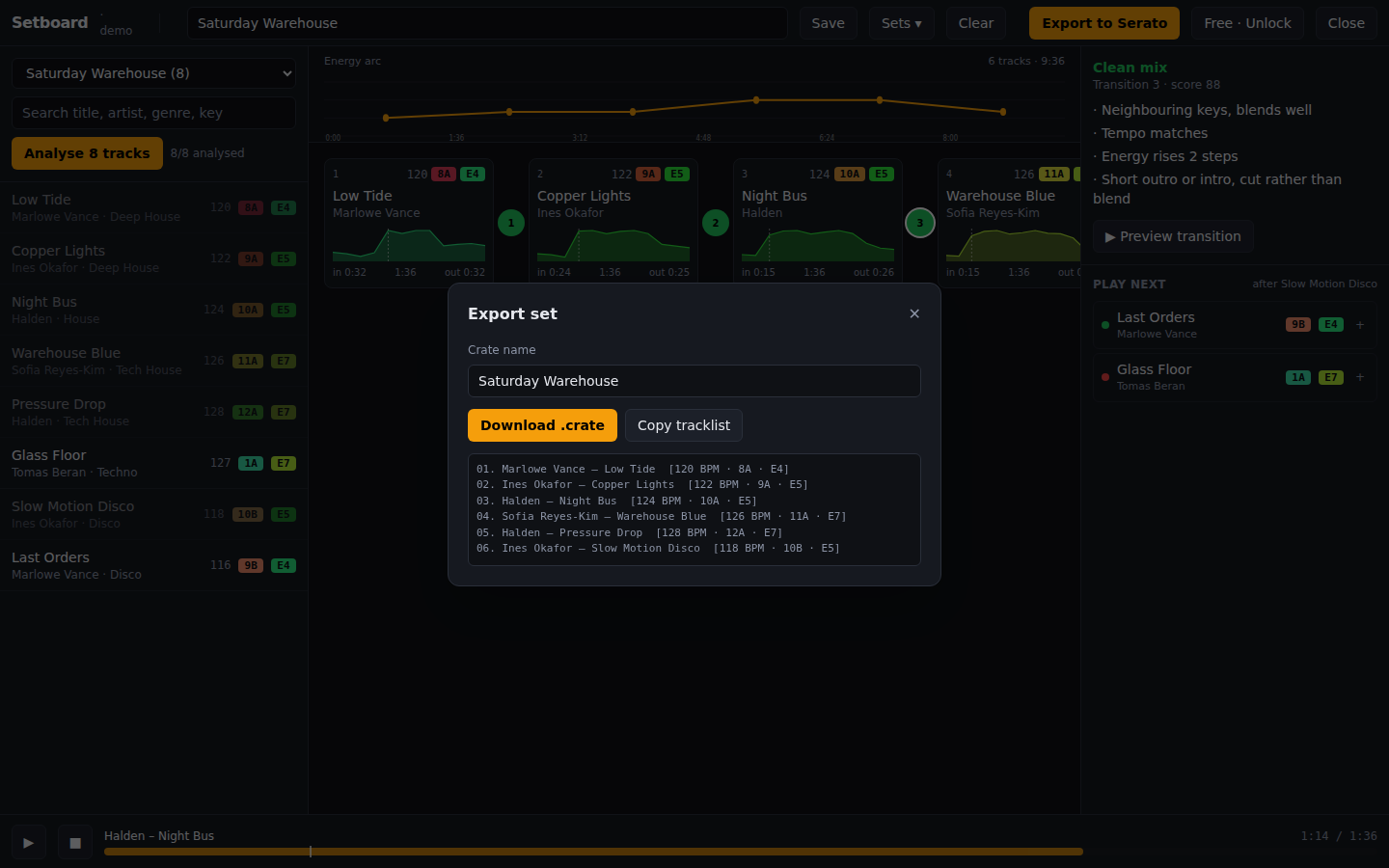
Name the set in the top bar and press Save to keep it in Setboard. Then press Export to Serato and Write crate into Serato. Chrome asks once for permission to write into _Serato_, and the dialog shows the exact file it saved, for example Music\_Serato_\Subcrates\Friday.crate.
Quit Serato completely and reopen it. Serato reads crates at launch, and the new one appears at the bottom of the crate list. Nothing else in your library changes: cue points, loops, beatgrids and the database are untouched.
In Firefox or Safari, or if you opened the folder the other way, Download .crate gives you the file to drop into _Serato_/Subcrates yourself. Copy tracklist puts a plain-text version on the clipboard.
7. Free and licensed
The free version analyses up to 50 tracks and saves 3 sets. Export is always included. A licence is a one-time US$24 and unlocks unlimited analysis and sets on up to 3 computers.
After paying, your key arrives by email within a minute. In the app, click Free · Unlock (or Licence key on the start screen), paste the key and press Activate. The key is checked once a week when you are online and keeps working offline in between.
Reference
What the pills mean
- · 124 tempo in BPM, from Serato or detected.
- · 8A key in Camelot notation. Codes that match or sit one step apart (7A, 9A, 8B) mix cleanly.
- · E7 energy from 1 to 10. Roughly: 1–3 ambient or beatless, 4–6 groove, 7–8 peak-time, 9–10 relentless.
How energy is scored
Six measurements from the audio, weighted: hits per second in the loud sections (0.35), brightness above 3 kHz (0.2), loudness (0.15), a mild tempo prior (0.15), bass weight (0.1) and how much of the track runs at full intensity (0.05). Loudness on its own is a poor guide because every modern master sits near the same level. Click a track in the Inspector to see each input from 0 to 1.
Keyboard
- · Space play or pause
- · ← → select the previous or next card
- · Delete remove the selected card
- · Esc close a dialog
Troubleshooting
Chrome says it can't open this folder because it contains system files
Chrome refuses the root of any drive (C:\, a USB drive), your user profile folder and Windows system folders. Pick the folder that actually contains _Serato_, usually Music. If your library is on an external drive, where Serato keeps _Serato_ at the root, use the Choose the folder the other way link on the start screen. It has no such limit; export then downloads the crate.
I exported a crate but it isn't in Serato
Serato reads crate files when it starts. Quit it completely and reopen it, then look at the bottom of the crate list. The export dialog shows the exact path that was written, so you can also check it in your file manager.
A track shows as unplayable or fails to analyse
Either the file is outside the folder you opened, or the browser cannot decode that format. Serato stores paths relative to the drive, so open a folder that contains all your music. Chrome decodes MP3, AAC, WAV, FLAC and OGG.
The energy score feels wrong for a track
Click the track and read the breakdown under its shape in the Inspector. Each input is shown from 0 to 1 with a tooltip explaining the raw measurement. A quiet, sparse track with a fast tempo can still score mid-range because of the tempo prior; a loud pad scores low because it has no hits.
Playback is silent
Browsers block sound until you have clicked something on the page. Click any button, then play again. Check the system volume and that the browser tab isn't muted.